
LIJ Med Tube
Depending on the temperature and the rate of cooling, steel can transform into different microstructures, which in turn determine its properties. Austenite, martensite, bainite, and pearlite are not four unrelated, distinct entities; rather, they represent four different “altitudes” reached by the same piece of steel as it travels along the “mountain path” of the cooling process.
Temperature × cooling rate; each of the four microstructures occupies one cell
The essence of heat treatment lies in “controlling temperature and cooling.” As supercooled austenite cools—passing through different temperature ranges at varying rates—it follows entirely different developmental paths:
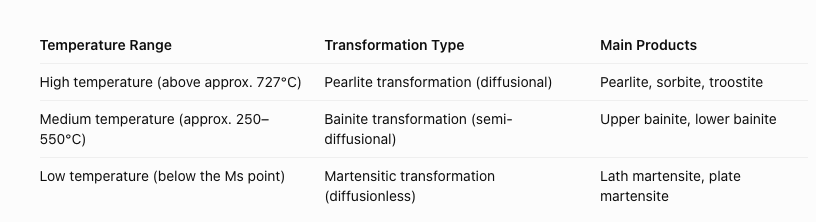
The faster the cooling rate, the greater the degree of supercooling, resulting in a finer microstructure and higher hardness—though this also brings increased brittleness. Let’s examine four types of microstructures, ordered by cooling rate from slowest to fastest.
Austenite—the “starting point” of every story
Austenite is an interstitial solid solution formed by carbon dissolved in γ-Fe; it possesses a face-centered cubic (FCC) structure and is non-magnetic. In essence, it serves as a “high-temperature transitional state”—before undergoing processes such as quenching, normalizing, or annealing, steel must first be fully austenitized (transformed into an austenitic structure) prior to controlled cooling.
However, austenite is not merely an “intermediate stage”; it holds two hidden values from an engineering perspective:
1.The “innate conditions” that determine subsequent organization
The finer and more uniform the austenite grains, the finer the resulting microstructure after cooling and the more stable the material’s properties. This is why the “heating and holding” stage cannot be skipped; uneven furnace temperatures or insufficient holding time can lead to mixed grain structures or underheating, which are common causes of fluctuations in material performance.
2.Retained Austenite (Ar) — An Often Overlooked “Hidden Phase”
During quenching, due to the limited cooling rate, some austenite fails to transform and becomes “frozen” in place at room temperature. In high-carbon steels, carburized components, and cold-work dies, retained austenite can account for 10%–30% of the microstructure. Its presence can:1
- Reduce the hardness (making it less hard than martensite);
Causes dimensional instability (slow transformation during use, leading to dimensional drift);
It can also absorb stress and increase toughness.
↩︎
When high-carbon components exhibit low hardness after quenching or significant dimensional changes following tempering, the presence of retained austenite is the primary suspect. Deep cryogenic treatment (using liquid nitrogen at -196°C) or sub-zero treatment (at -78°C) are the most common engineering solutions for this issue.
Pearlite—A “Layered Sandwich” Formed by Slow Cooling
When austenite is supercooled below the A1 temperature, it undergoes eutectoid decomposition: ferrite (F) and cementite (Fe3C) precipitate simultaneously, stacking in an alternating, lamellar arrangement to form pearlite (P)—so named for the mother-of-pearl-like luster it exhibits after being polished and etched.
Depending on the cooling rate—from slow to fast—pearlite exhibits three “degrees of fineness”:
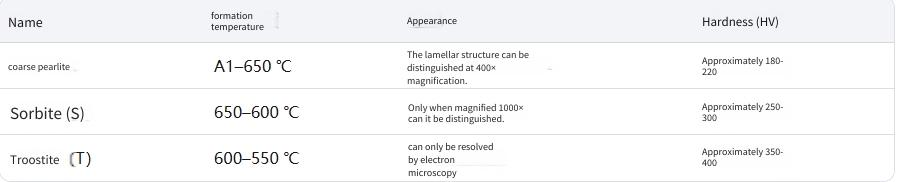
Key Engineering Points:
Normalizing followed by air cooling yields sorbite, which is the most common preliminary microstructure for structural components (such as shafts or gear blanks), as it provides a well-balanced combination of strength and toughness.
Spheroidizing annealing yields granular pearlite, in which cementite is distributed as particles within a ferrite matrix; this structure offers low hardness and good plasticity, specifically preparing the material for subsequent machining or cold extrusion.
After rolling, high-speed steel undergoes air cooling to form troostite—a structure also known as “white-spot microstructure.” The product obtained from the high-temperature tempering of hypereutectoid steel is likewise referred to as tempered troostite.
Bainite: The “Two-Faced” Phase of the Intermediate Temperature Range
When the cooling rate is fast enough to bypass the pearlite transformation but not rapid enough to result in the formation of martensite, the supercooled austenite enters the intermediate-temperature transformation range (250°C–550°C), leading to the formation of bainite (B).
Bainite is a composite microstructure consisting of ferrite and carbides, yet its morphology is entirely distinct from that of pearlite. This is the origin of its “dual-natured” character: within the intermediate temperature range, the process further bifurcates into two sub-regimes, yielding products that differ drastically from one another.
Upper bainite (B_upper, 350°C–550°C)
Morphology: Lath-like ferrite grains arranged in parallel bundles, with short, rod-shaped carbides distributed discontinuously along the direction of the laths, creating a “feathery” appearance.
Performance: Low strength and poor toughness; generally to be avoided in engineering applications.
Cause: At higher temperatures, carbon has sufficient time to diffuse beyond the ferrite boundaries, resulting in a “dispersed” distribution of carbides.
Lower bainite (B_lower, 250°C–350°C)
Morphology: Fine carbides precipitate within acicular (needle-like/lath-like) ferrite, with the carbides oriented at an angle of 55°–60° relative to the long axis of the ferrite.
Properties: High hardness (HRC 40–55), good toughness, and minimal deformation—it is a “star microstructure” in engineering.
Formation mechanism: At lower temperatures, carbon can only precipitate “in situ” within the ferrite, resulting in a fine and uniform distribution of carbides.
Why pursue lower bainite?
Compared to martensite: lower internal stress, less prone to cracking, and does not require high-temperature tempering.
Compared to pearlite, it possesses a higher level of strength and hardness.
Processing method: Isothermal quenching (quenching the workpiece into a salt or alkali bath at 250°C–350°C, holding it there for a period of time, and then cooling it in air).
Typical applications include springs, bearing rings, molds, chains, and high-strength fasteners. For bearing rings made of GCr15 steel, an isothermal quenching process to produce a lower bainite microstructure can significantly enhance impact toughness and dimensional stability while maintaining the required hardness.
Martensite—The “Tough Guy” Born of Rapid Cooling
When the cooling rate is sufficiently high that the undercooled austenite lacks the time to undergo diffusion, the crystal lattice must instead reconstruct instantaneously via a shear mechanism (a non-diffusional process). In this transformation, carbon atoms are forcibly “pinned” within the α-Fe lattice, resulting in a body-centered tetragonal (BCT) structure—this is martensite (M).
Martensite is a non-equilibrium microstructure; it exists only along the extension of the Fe-C phase diagram and, therefore, cannot be represented on the diagram itself.
Two basic forms:
Lath martensite: The primary morphology in low-carbon steel (<0.6% C), characterized by parallel, bundled laths and relatively good toughness.
Lath-like (or plate-like) martensite: The primary morphology in high-carbon steel (>1.0% C), characterized by a needle- or plate-like structure. The plates formed earlier are larger, while those formed later are smaller; the structure contains numerous micro-twins and micro-cracks, resulting in significant brittleness.
In medium-carbon steels (such as 40, 45, and 40Cr), a mixture of two types of martensite may be present; their properties depend on the alloying elements and the quenching process.
Performance characteristics of martensite:
With extremely high hardness (HRC 50–65), it serves as the essential structural foundation for cutting tools, molds, and bearings. It possesses significant internal stress, necessitating immediate tempering. Its large specific volume—approximately 4% greater than that of austenite—is the root cause of deformation during quenching.
Tempering is a “life-extender” for martensite:
Low-temperature tempering (150°C–250°C): Retains high hardness while relieving internal stress — used for tools and bearings. Medium-temperature tempering (350°C–500°C): Produces tempered troostite, offering a balance between strength and toughness — used for springs and molds. High-temperature tempering (500°C–650°C): Produces tempered sorbite, providing optimal overall mechanical properties — used for connecting rods, gears, and shafts (quenching and tempering treatment).
Select the microstructure based on operating conditions, then choose the steel grade.
Subjected to impact loading → preferably lower bainite or tempered sorbite.
Subjected to friction and wear → preferably tempered martensite or lower bainite.
Subjected to alternating stress → tempered sorbite is preferred (as it possesses the highest fatigue limit).
If non-magnetic properties are required, choose austenitic steel (such as 304 or 1Cr18Ni9Ti).
Even with the same steel grade, performance can vary by a massive margin.
Taking 45 steel as an example:
After annealing: approximately HB 170; low hardness, easy to machine.
After normalizing: approximately HB 200, sorbite; strength and toughness are enhanced.
After quenching and tempering: approximately HB 250, tempered sorbite; offers the best overall combination of properties.
Quenching + low-temperature tempering: HRC 55—tool-grade hardness, but with high brittleness.
A summary in five sentences
1. Austenite is the starting point: the heating and holding process determines how far one can go down the subsequent path.
2. Pearlite is the “slow-paced” option—the standard result of air cooling or furnace cooling.
3. Bainite formation relies on isothermal treatment: salt-bath or alkali-bath furnaces are the key equipment.
4. Martensite formation relies on rapid cooling followed by tempering; neither step can be omitted.
5. Microstructure determines properties, and properties dictate processing: these three form a closed loop—don’t focus solely on hardness.